"The conventional wisdom unconventional way" keep yourself updated with latest mind boggling questions and & new methods of solving problems.

Mock CAT 3 Analysis

Overview:


In this paper, Verbal Ability was on the easier side, whereas Quantitative Ability section was tough, and Logical Reasoning based Data Interpretation sections was moderate.
The information the cover page made available to you was:

  • There were 75 questions in all, distributed over three sections.


  • Each section had 25 questions and carried 4 marks for each question.


  • Wrong answers carried negative marks equal to one-fourth of the marks allotted to the question.


  • Total time available to answer all the sections was two and a half hours.
Executive Summary:
A synopsis on how this paper could have been attempted is:
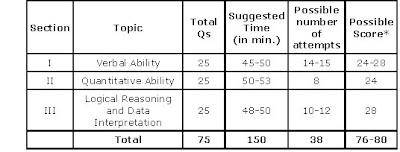


*Note: The number of attempts and the score has been worked out on the basis of the experts’ insight on how the students would have taken the test and what score IIMs have been considering for dispatching the call letters. The correct cut-offs can be confirmed statistically only after seeing the actual performance of all of you.

SECTION I: VERBAL ABILITY

In this paper, Verbal Ability was of easy-moderate level of difficulty. This section must have been a morale booster for you after Mock –1 and Mock-2. Let us do a specific analysis of this section.

A glance at the section would have revealed to you the order of attempts.

You could have attempted the section in the following order
1. Fact Inference Judgement - 7-8 mins
2. Para-completion – 15 mins max
3. RC Passages- Rest of the time!

1. Fact Inference Judgement: Qs 16-20

A good starter. You could have attempted all 5 questions. Q 17 was probably a bit tricky. The others were easy. In 7-8 minutes a score of 12-16 was a sure possibility.

2. Paracompletion:Qs 1-5

These were a mix of levels of difficulty. You could have attempted all –probably getting 2-3qs correct and in the process notching up a net score of 8-12.

3. Reading Comprehension:

You would have found out that passage 3 was an easy passage. The other two were of moderate difficulty. Assuming that you attempted one passage reasonably accurately , a score of 8-12 was a possibility here.

Taking account of test conditions a score of 24-28 looks very much possible. If your English and reading are up to the mark then you could score even above 30 in this section.


An attempt of 14-15 could have yielded a score in the range of 24-28.

PS: The above attempts and possible score have been derived based on sample simulation of the paper. They are subject to variance under actual test conditions.

SECTION II: QUANTITATIVE ABILITY

The quantitative ability section of this Mock CAT was tough in its difficulty index. Few questions demanded clarity in concepts as maximum portion of the paper constituted number theory, Algebra and geometry and there were only few problems, which could be done by smart work.

In Q. 28 realize that straight lines at a distance of 1 unit from the origin with slopes 1 form nothing but a square of side length 2. Hence, the area is 4 sq. units.

Q. 29 was the one that could have been solved by smart work. Observe that T100 = 98/100 * 101/103. Since, this is the last term and contains 103 in the denominator, then so should S and hence the only feasible answer is option 1.

In Q.32 It effectively means the remainder when S is divided by 1000. Lets remove a factor of 50.So now we have 883*881*871*873*35*439 when divided by 20=>3*1*11*13*(-5)*(-1) => 5 when divided by 20.Since we had removed a factor of 50 so we multiply it back to get the final result i.e. 5*50 = 250

In Q. 38 was a conceptual problem, which required you to know total product of the factors of N and total product of the factors of N, which are not multiples of 5.So, total product of the factors of N, which are multiples of 5 could be calculated.

Q. 39 required you to arrange the given equation to yield (m-1)(n-1) = 37.Now it could be seen that for (m, n) = (38,2) and (2,38), option 1 & 3 satisfy. Also, we could have m = 0 or n = 0 so that we get –1 & 2 also as the values for the expression.

Q. 41 could have been solved by elimination of options. For x = -0.5, y = 1-3 = -2
Option 2, 3 & 4 are eliminated. For x = -1.5, y = 3-6 = -3, which also satisfies option 1 and hence the answer.

In Q. 42 one could have put the value of one variable from the linear equation into the quadratic and evaluated the discriminant of the resulting quadratic and made it greater than equal to 0 to obtain the desired range. A must attempt for sure.

Q. 45 also required you to plug in values to establish relations within functional values at different points. Putting x = 0 & x = 1, we get f(3) – f(1) = 2.Putting x = 2 & x = -1 and solving we get f(0) + f(1) – f(3) – f(4) = -6=> f(0) – f(4) = -4 => f(4) = 5.

In Q. 48 is another good question. In case the similarity condition did not strike you, sine rule could have made life easy. Let CM = b & CN = a, BM = 5x, DN = 5y, z = 3a = 2b

Q. 49 and 50 were not that tough a nut to crack if you have a concrete knowledge base. If N = abc, K = 20+81(a+c)/(a+b+c). To minimise K we minimise a+c & maximise b. Maximum value of b = 9 & minimum possible value of a+c = 3+0 = 3.Hence, minimum K = 20+81/4 = 40.25.
Also, a+b+c = 17 such that 101a+20b+101c = 96*17+4 = 1636.The only possible value in the given range is for N = 719.719 when divided by 17 gives a remainder of 5.
Hence, a considerable number of questions could have been attempted. With 8 attempts and a decent accuracy of 75%, a score of 22-24 was definitely attainable.

SECTION III: LOGICAL REASONING AND DATA INTERPRETATION

LR/DI section in this paper was of moderate difficulty level. Proper selection of easy sets would have really boosted your score. Lets see them one by one.

Set 1(Q.51 to 55)

Basically one needs to establish a tabular relation among the batches, days, subjects and the name of faculties on the basis of the conditions given and taking care that none of them gets violated. Once the table is ready, the questions can be tackled one by one on the basis of the table. But attempting this set could have proved wrong as it may have taken longer time to comprehend and formulate the right table.

Set 2(Q.56 to 60)

Relation could be established among the number of students who wrote exactly one, exactly two and exactly three names and then their possible values could be observed.56 and 57 could have been answered on this. For the rest of the problems the additional information was to be used which could have given you 2 cases in which the name of candidates along with the number of times their names were written in the first choice and also in the remaining two choices. It would be smart to attempt 2 sitters from this set and proceed to the next set.

Set 3(Q.61 to 65)

This set was a cakewalk. One could have formed a tabular relation of the possibilities. From statement 1 Shane received 0 cookies. From statement 3, Shane and Chris, and Matthew and Graham can have [(0,1)(2,3)] or [(0,2)(1,3)] or [(0,3)(1,4)] cookies respectively. Using statements 2 and 4 we can conclude that only possible case is [(0,3)(1,4)]. So Greame must have got 2 cookies. Using statement 1 and statement 7 we can say that Graham and Greame like wrestling shows, as Shane likes a sports show and there are only two sports shows. From statement 5, Matthew likes Smack down and Shane likes Sports Center. So Chris likes Hitz.From statement 6 Graham likes Krackjack. From statement 8 Greame likes Hide n Seek or Good Day. Shane likes Good Day or Bon-Bon. Matthew likes Hide n Seek or Bon-Bon or Good Day. It would have been criminal not to have attempted this set.

Set 4(Q.66 to 70)

Another easy set in the offering. From the table since A, C, E, F, G, H, L all have more than 1 entries as same which means they can never be the one who predicted all correct. Now, we needed to check only for the remaining five friends. I happens to be the one who counted all-correct as we could have all 12 combinations mentioned as in the question. All the questions could be attempted one by one after finding out the right combination of counts for all the baskets. This set was also one among those that must have been attempted.

Set 5(Q.71 to 75)

This is the easiest of all sets. It should not be a surprise if one is told that it was very much a 6-7 minute set. Approach could have been slightly different here. Assume A = 4 be the first mine. Then rest of the mines are given by: B = 14, G = 7, D = 12, I = 19, E = 20, J = 26, C = 29, F =31, H = 36. As per question 71 if A = 4 is not a mine then none of the above hold for a mine. Hence the right answer is 12.As per the question 72 block 14 & 16 are mines. It is obvious that a shift of 2 blocks will result in all the mines so that the first mine is A = 6. Since, 27 is not in the above list 29 cannot be the block which contains mine. For 73, 1-6-> 6-11-> 11-17-> 17-23-> 23-28-> 28-34-> 34-40-> 40-42.In 74,total number of mine counts if removed from total number of blocks would yield maximum number of throws i.e. 42-10=32.For,75 E can be maximum when A = 6 => E = 22.Also J can be minimum when A = 1 => J = 23. Hence, the difference can be 1.
This set was a must attempt.

This translates to an attempt of about 10-12 questions. With a realistic accuracy of 70%, a score of 26-28 could have been achieved.


All the best!!
Mock CAT 2 Analysis

Overview:

The pattern has been adapted from CAT 2005, except that it offered you half-an-hour extra.
In this paper, Quantitative Ability, Verbal Ability and Logical Reasoning based Data Interpretation sections were all of marginally above average difficulty level, having few questions in each section that could be easily managed. Overall, a paper not as easy as the 1st mock we gave but still the one that gives you a good feeling thanks to a few easy sets of questions.

The information the cover page made available to you was:
There were 90 questions in all, distributed over three sections.
Each section was divided into two sub-sections. Sub-section A carried 1 mark for each question whereas Sub-section B carried 2 marks for each question.
Wrong answers carried negative marks equal to one-third of the marks allotted to the question.
Total time available to answer all the sections was two and a half hours.

Executive Summary:

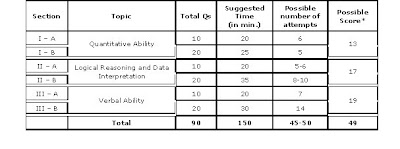
A synopsis on how this paper could have been attempted is:

*Note: The number of attempts and the score has been worked out on the basis of the experts’ insight on how the students would have taken the test and what score IIMs have been considering for dispatching the call letters. The correct cut-offs can be confirmed statistically only after seeing the actual performance of all of you.

SECTION I: QUANTITATIVE ABILITY

Sub-section I-A:

If you are one of those who start answering 1-markers first, this sample gave you all the reasons to pay regards to your strategy right then. You could have started with 1, 2, 3, … and went on answering almost all of them one by one with very few untimely speed-breakers. For instance,

In Q. 1, the general term of the series is nlog3/2log3 = n/2.Hence, our series is nothing but ½+1+3/2+… +n/2 = n (n+1)/4

In Q. 2, the series is equivalent to 9(4k+1) * 8(4k+2) * 7(4k+3) * 6(4m) * 4(4m+2) * 3(4m+3) * 2(4n). Hence, the last digit is decided by 9*4*3*6*6*7*6 => 6 which is the required units digit.
In Q. 3, BD=BF*BA/AF and all these lengths are determinable using Pythagoreans theorem.

In Q. 5, Put x = 0 and eliminate options 3, 4 & 5 straightaway. Put x = -1.3 and eliminate option 2 as well.

In Q. 6, Its worth noting that 3^12k as well as 7^12k gives remainder 1 when divided by 13.Hence, the required remainder = 3+1 = 4


Q. 7 was on the most traditional AM-GM funda. Take a/2 = b/3 = c = k. Hence, k = 2/3 (as per the given condition). So, minimum value = 2k+3k+k = 6*2/3 = 4
Whenever you see anything like

Q. 8, go straightaway to the answer options. If the total number of dogs is N out of which x are Pomeranian, then the ratio = x/(N-x). Since, numerator & denominator in all the answer options are relatively prime the idea should be to check the sum of them and see which of them gives a composite number.

Sub-section I-B:

Coming over to the 2-markers, you would have realised that the life is not so beautiful. There weren’t many questions done as easily as in the previous sub-section. Yet,


Q. 11 again dealt with the same concept as problem 7. As the sum of 13 – x & x + 7 is 20, here take (13 – x)/7 = (x + 7)/3 = k => k = 2.Hence, the greatest value of the expression = 147 * 63 = 210 * 33 * 77 and hence the answer.


Q. 12 could have been a blunder had you not noticed the term successively divided. Condition 1 yields 5(4(3m+2)+1) + 3 = 60m+48 = 72a+12(from second condition). So m gives remainder 12a+24 when divided by 60. So, a starts from 3 corresponding to which n = 228. Hence, the general solution for n = 228+360z. There are 8 such Ns in the given range.


In Q. 14, Apply AM >= GM for positive reals and obtain (a+b+c)(b+c+d)(c+d+a)(a+d+b) >= 34 (abcd). Hence, S1*S2*S3*S4 >= 81*5 = 405.


Q. 18 required a simple manipulation. Taking care of the fact that the last digit of the three numbers should sum upto 9, from the last digits possibilities we get the last digit of the product as all the digits accept 3 & 8. Hence, only 2 possibilities.


Q. 21 looks intimidating on a cursory look but is not the case. The given function effectively translates to (x – f)1/2 ,where f is the fractional part of x.Hence, the required value = .8 * .8 = .64


In Q22, assume the value of a=12 km/hr=200m/min .So, 2.5a = 500m/min and 4a = 800m/min. Also assume, he drives at 200m/min for 30 mins, 500m/min for 20 mins and 800m/min for 25 mins. Compare both the cases and get the value of exact time he takes in driving at 800m/min.


Q. 24 could have puzzled many of you but you will know how easily you could have done it. (0,2) translates to (-1,1) and (3,0) to (2,-1) in the new reference frame. All the answer options accept 3 can be eliminated on this. Only option 3 satisfies the above translation.
It would be criminal not to have attempted

Q. 30,one of the easiest problems in the 2 marks basket. It can deduced that –4<= x <= 8 and –9<= y <=11. Hence, -26<= (x-2y) <= 26 It will always happen that some questions made you feel like attempting them, but you could just not crack them. Or possibly, you didn’t know how you could have proceeded from a particular junction. The reasons range from your unfamiliarity with the concepts to the bitter phase of your fortunes. A major chunk of MBA aspirants fall into this category as far as the QA section goes. So, the best possible service you can do to yourself in such a scenario is to avoid wasting precious time juggling with the concepts and move on to those you could do with certainty.

Assuming an accuracy of 75%, a score of 13+ is possible.

SECTION II: LOGICAL REASONING AND DATA INTERPRETATION

This was a section where within 2-3 minutes of observation of any set, you were able to realise if the questions were attemptable or not.

Sub section II-A:

Set 1(Q.31 to 35)

Distance data was represented by bar graphs and fare and stops data by tables. An average set difficulty wise. Questions 31,32 and 35 were the ones to be attempted quickly as they did not require much effort once you get hold of the logic to crack this set mainly the one that says “anyone taking ticket of any denomination makes full utilization of the ticket and boards down only when the ticket is just about to be invalid or the bus reaches its terminus.” After doing these 3 one could have felt comfortable with the set and cracked the next 2 also.

Set 2(Q.36 to 40)

One could have established the relation between the cards with A & B at the beginning of round 1 and then establish a tabular possibilities for both. From the additional information in the set one could have found the only possible ways in which the cards could have been exchanged. All the questions could be answered once the possibilities were in front of you.

Set 3(Q.41 to 45)

Aah! A must attempt indeed. The whole idea was to realise that there should be one process in which marbles are getting halved for each of the people. B & C cannot have ½ in the first process as in that case the number of marbles with both of them will go out of range. So, A must have ½ as his first step. All the problems where to be considered one by one and using the basic logic should have been cracked in about 12-13 minutes. Really a gift in disguise.

Sub-section II-B:

Set 4(Q.46 to 50)

One could have found out the marks obtained in the test by different people in terms of the aggregate obtained by them in 5 tests together and also utilised the other condition. Then one could have gone about attempting 46, 47 and 48 and once into the groove could have gone on to solve the full set. One should be very wary while doing such sets as a slight fault in observation or representation can cost you the entire set. Be extra careful with regard to the mother data.

Set 5(Q.51 to 55)

A set, which would give you, an impression of familiarity with the concepts involved. Of course it is true but as you would have advanced into the set, you would have realized that the combinations were a bit dicey to frame. The basic logic to crack this set would be to understand that a particular school having one particular medal cannot have the individual sum of the same medal amongst its students more than one. Basically, we have to eliminate cases where the above said logic does not hold true. Forming various combinations, logically it boils down to a combination where we can have 2 possibilities because Vipul & Wasim combined represent similar medal tally as represented by Umesh alone. A good enticing set, wherein not following the right track would cost you both marks and time loss. One could have given 2-3 minutes and realized whether or not progress with this set.

Set 6(Q.56 to 60)

It’s important to deduce that the 6 companies except Mitsubishi and Renault could have manufactured a minimum of 9 and a maximum of 11 cars. With the given information the range of cars manufactured could be found out. In the 12 months period. Then a tabular collation of maximum and minimum number of cars by different brands along with their optimum index and average index could be done. Then one could have gone about attempting all the problems one by one in this set. Hence, about 12-14 questions from this section could have been attempted.

Assuming 75%+ accuracy, a score of 17+ was easily possible.

SECTION III: READING COMPREHENSION AND ENGLISH USAGE

Verbal Section of this test is also meant to be a wake-up call for CAT aspirants. The difficulty level is meant to be a notch higher than Mock CAT-1 Let us take a closer look at this paper! In this paper, Verbal Ability was of medium level of difficulty. There are many reasons this section could have caught you off-guard; however, it definitely presented a section in which you could have attempted a fair number of questions easily and cleared the cut-off. The section had a mixture of questions from the past CAT question types. Let us take a look at the questions.


Sub Section III-A(1 mark)

Questions 63-66 (Word Usage)

A good starter for the English Section. A set of must attempt 1-mark questions to boost your confidence and start off the section. You could have attempted all of them and got if not all 4 then at least 3 correct.

Questions 61,62 (Synonyms in context)

These were two difficult 1-mark questions. These tested your vocabulary. You could have got at least one correct.

Questions 67,68 (6 Sentence Para jumbles)

Two medium level difficulty questions to make you rack your brains to a certain extent, you could have got at least one of them correct.

Questions 69,70 (7 Sentence Para jumbles)

These two questions could have been left since they were worth 1 mark each and would have wasted a lot of time.

Sub Section III–B (2 marks)

Questions 71-73( Sentence Correction)

Three questions of easy- medium level of difficulty, a must attempt chunk. You could have got at least two of them correct.

Questions 74-76(Critical Reasoning)

Three questions of easy- medium level of difficulty, you could have got at least two of them correct out of 3 attempts.

Questions 77-81 (Passage –1)

When the going gets tough, the tough get going! This was a passage, which really tested your reading skills. But the questions were doable. Out of 5 attempts you could have got at least 4 correct.

Questions 82-85 (Passage –2)

A passage which was difficult to read and had questions which were of higher level of difficulty. You could have skipped this.

Questions 86-90 (Passage –3)

A passage, which was relatively easy to read. Some of the questions were tricky, requiring you to read in between the lines. All the questions could be attempted out of which 4 could be correct.

An attempt of 22-24 questions with 80 % accuracy could have yielded a possible score of 17 in 50-55 minutes.

All the best!!

The Magical Number 142857

So, what's the big deal about a number, you would say! Well, not if this number graces the cover of a book called "The Joy of Numbers" by Shakuntala Devi.

The great thing about this number is when multiplied by an integer you have an 86% chance of the digits just kind of shifting around. Look at this:

142857 = 142857 x 1
285714 = 142857 x 2
428571 = 142857 x 3
571428 = 142857 x 4

See the pattern? All the numbers on the left are just the digits 142857, just in different orders, BUT, 142857 x 7 = 999999.... An implication of the fact that 1/7 = 0.142857 repeating. There are tricks to make the trick continue working for much larger multiples... but you can figure those out on your own... does this have application? Definitely not, but it will help you remember the decimal equivalents of fraction multiples of 7.

1/7 = 14.2857%
2/7 = 28.5714%
3/7 = 42.8571%
4/7 = 57.1428% and so on...

It can be very useful in calculations involving a multiple of 7 in the denominator. BTW, remember the irrational number pi? It is approximated as 22/7, which is a rational number. A rational number must be terminating or recurring decimal. And can you now guess the exact value of 22/7? Yes, that's right...its 3.142857 recurring! Of course, pi value is non-recurring and non-terminating...I heard someone worked hard on a program to find its value to trillion places.

Now for some interesting stuff that I found related to this number...and I quote

"The tune "Further and In Between" takes its basis from the cyclical number 142,857. Cyclical numbers are actually the inverse of certain prime numbers. For example, the number 142,857 represents the first six repeating digits of 1/7 in decimal form (0. 142857142857142857...). Also, a cyclical number with n digits, when multiplied by any whole number from 1 through n, will generate a product consisting of the same digits, which in every case except for when the multiple is 1, will be in a different sequence. Mahanthappa took various forms of his chosen number (142,857; 428,571; etc.), strung them end-to-end, and assigned a musical pitch to each digit. Allowing some leeway in melodic direction—tweaking pitch as needed—and working in some funk-based, start-and-stop rhythms, he constructs a jagged, leaping melody as visceral as it is intellectual."

You may read the whole article here about Rudresh Mahanthappa who brought maths into the music room.

Concepts on remainder theorem

Fermet’s theorem

If ‘a’ and ‘p’ are two numbers such that p is prime number then

( a) ^p-1 divided by p will always leave remainder 1

For example 16^38 when divided by 7 then by ferments 16^6n divided by 7 will give remainder 1

further 16^2 divided by 7 will give remainder 4.

Euler’s theorem

When ‘a’ and ‘p’ are coprime and p is not prime number than a ^E divided by ‘p’ will leave remainder 1 , given

E = p( 1- 1/x) (1- 1/y)

Where x and y are prime factors of number, note we are not concerned with powers of x and y.

For example E for hundred will be
100 = 2^2 * 5^2

E = 100(1-1/2) ( 1- 1/5) = 40

So 3^ 80 / 100 will give remainder 1 by Euler’s theorem

ANNOUNCEMENT FROM IMI

hello,

IMI has announced their prerogative. Read futher to know more.......

The Delhi-based International Management Institute (IMI) will stop giving any weightage to an applicant's CAT score once she is selected for the interview stage starting this admission season, IMI Director Prof CS Venkata Ratnam. The weightage will be more for work-ex.

Relative Pronouns Explained

There seems to be a perpetual confusion in usage of relative pronouns among students. If one finds pronouns a tough ball game then relative pronoun seems totally out of the league. I guess, after going through the following post on usage of relative pronouns, life could be little smooth than it was earlier, in context to relative pronouns.

A relative pronoun links two clauses into a single complex clause.Now look at the following examples:

1. I met Akil who had just returned from Kerela.
2. I have found the book which I had lost.
3. Here is the bag that you lent me.

‘ who’ joins or connects two statements as well as does the work of a pronoun. ‘who’ relates to some noun ( here,akil) which is called its antecedent.

Similarly ‘which’ and ‘that’ are also relative pronouns.

Difference between ‘conjunction’ and a ‘relative pronoun’:

Conjunction just joins two clauses or sentences but relative pronouns joins two clauses and is used in place of a noun.

This is a house.
Jack built the house.

This is the house that Jack built.

Different pronouns are used for human and non human antecedents.

Relative prounouns can of 2 types:

(i) Simple relative pronouns: which, who, whom, that
(ii) Compound relative pronouns: whichever, whoever, whomever.


Simple relative pronouns

WHO Vs WHOM:

Who/ whom is used for human antecedents.

Who is used in subjective case.e.g.

This is the boy who works hard.
‘who’ is used for the subject( boy here).

Whom is used in objective case.e.g.

This is the boy whom all praise.
‘whom’ is used in the place of objective case in the sentence, note that the object in the sentence is ‘the boy’.

Relative pronoun is generally marked in its form. This survives only in who, which has a possessive case form whose and an objective case form whom.

Which and that have no possessive forms.

When a preposition is used the pronoun must be either whom or which and never that.


WHICH Vs THAT:

Which and that both takes non human antecedents and hence a frequent point of dispute.

That is used for restrictive clause and on the other hand which is used for non restricitve clause.

The actual job of identifying restrictive and non restrictive clauses.

A non restricitve clause is normally preceeded by a comma where as restrictive clause is not.e.g.

The builder,who erects very fine houses,will make a large profit.
( this is an example of non restrictive clause, a specific builder is referred here.)

The builder who erects very fine houses will make a large profit.
(this is an example of restricitve clause, refers to any builder who builds such houses will make profits.)

Compound relative pronouns

1.You may invite whomever you like to the party.
The relative pronoun ‘whomever’ is the direct object of the verb ‘may invite’.

2.Whoever broke the window will have to replace it.
‘whoever’ functions as the subject of the verb ‘ broke’.

3.I will read whichever manuscript arrives first.
‘whichever’ modifies the noun ‘amnuscript’ which functions as the direct object.


Read the above and relative pronouns would be definitely smooth sailing.

Search This Blog

The Contributors

RAVI's KNOWLEDGE CENTER
View my complete profile

Blog Archive

Distributed by eBlog Templates